
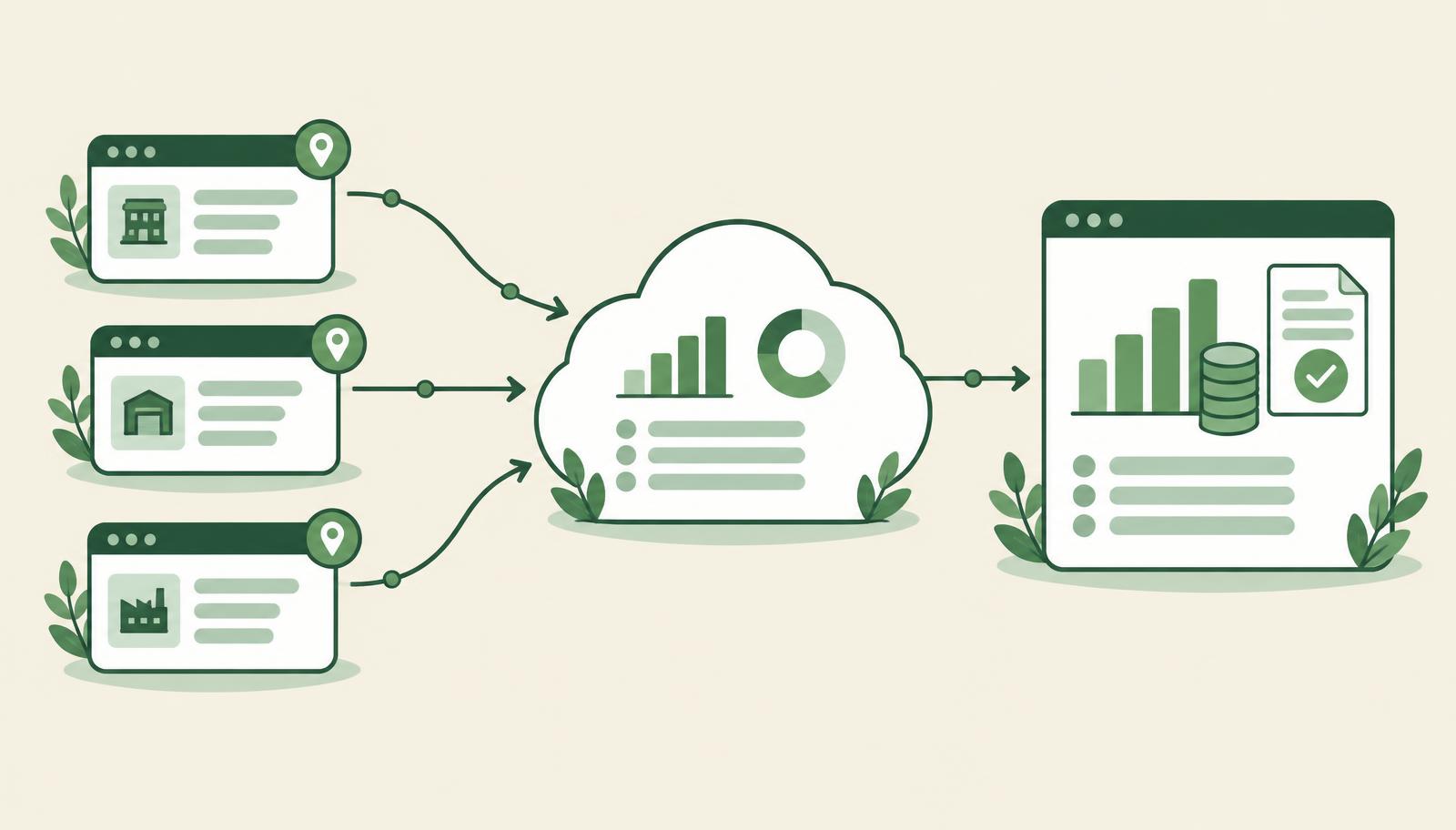
Looking for an ERP for multinational companies with entities in Serbia and in Germany or Switzerland? The short answer: choose a cloud system that runs the whole group on one platform while each company follows its own local rules. For the Serbian subsidiary that means a direct connection to SEF, POPDV and the NBS exchange rate list; for the DACH entities it means local accounting rules, tax reporting and group consolidation.
In practice, groups rarely struggle with the big features. They struggle with the details: e-invoices are sent manually through a portal, exchange rate differences are calculated in Excel, and consolidation for the parent company takes days. This article walks through the requirements on both sides and how to compare the types of ERP systems you will meet on the market.
What a Serbian subsidiary must comply with
A Serbian company inside an international group has obligations that global ERP systems do not cover out of the box. Before you choose a system, check that it handles:
- SEF (the Serbian e-invoicing system): sending outgoing and receiving incoming e-invoices directly from the ERP through the API, with statuses (accepted, rejected, cancelled) visible on the document itself.
- POPDV and the VAT return: POPDV data should come from postings, not from retyping figures into a spreadsheet.
- NBS exchange rates: automatic import of the National Bank of Serbia middle rate and posting of exchange rate differences.
- Chart of accounts and reports: posting according to the prescribed Serbian chart of accounts and the reports the local accountant and auditor need.
- Local documents and payments: Cyrillic and Latin script on documents, payment orders and statements from Serbian banks.
If the global system lacks this, the result is always the same: parallel records. The finance team in Serbia works in one tool for the law and in another for the group. You can read more about automating supplier invoices in our article on automatic incoming invoice processing.
What the DACH side needs: Germany and Switzerland
A parent company in Germany or Switzerland looks at the group differently. What matters to it:
- Local accounting requirements: in Germany, orderly and auditable bookkeeping and data exports for the tax advisor; in Switzerland, local VAT (MWST) and payments with the QR-bill.
- E-invoices in the DACH region too: Germany has introduced a mandatory obligation to receive B2B e-invoices, so the parent company must also work with structured invoices.
- Consolidation: group financial statements, elimination of intercompany items, and translation of dinar amounts into euros or francs under clear rules.
- One view of costs: the same cost centres, projects and dimensions in every company, so comparisons make sense.
Tax and accounting rules differ by country, so always confirm the specific obligations of each entity with a local tax advisor or auditor.
How to compare ERP options for an international group
You will meet three types of solutions. Instead of comparing brands, it is more useful to compare how each type meets the requirements above.
| Criterion | Large global ERP suites | Mid-market cloud ERP without a local partner | Business Central with Serbian localization |
|---|---|---|---|
| SEF, POPDV, NBS | Usually a separate project or add-on | Often manual or through the portal | Part of the localization, directly in the system |
| Localization for Germany and Switzerland | Available | Depends on the vendor | Microsoft localizations for DE and CH |
| Group consolidation | Advanced but complex | Often available | Built-in consolidation and intercompany postings |
| Implementation time | Usually longer and more expensive | Depends on scope | Typically 12 to 18 weeks for a standard scope |
| Best fit | Large corporations | Companies with a simpler structure | Mid-sized and growing groups with entities in several countries |
Large global suites make sense when a group has very complex processes and the budget for a long project. For mid-sized groups, where the Serbian company has dozens or a few hundred employees, it is often decisive that the system covers local rules without custom development.
When you compare vendors, ask them to show a concrete flow in the demo: an outgoing invoice sent to SEF from the ERP, an incoming invoice received from SEF and posted, exchange differences calculated at the NBS rate, and a consolidated group balance sheet in euros. If any of these steps needs Excel or retyping, you know where your team will lose time every month.
Why Business Central works for a group in Serbia and DACH
Microsoft Dynamics 365 Business Central is a cloud ERP in which one group can run several companies, each in its own currency and with its own chart of accounts. Microsoft maintains the localizations for Germany and Switzerland, while the Serbian localization is provided by a partner.
Key capabilities for an international group:
- Several companies and currencies in one system: dinars, euros and francs, with automatic exchange rates.
- Intercompany postings: an invoice between two group companies is posted on both sides without double entry.
- Consolidation: group reports with currency translation, described in Microsoft's documentation on consolidation.
- Dimensions: the same projects, departments and cost centres in all companies.
HOLYERP delivers Business Central in the cloud with a complete Serbian localization: direct SEF integration for incoming and outgoing invoices, POPDV preparation, NBS exchange rates and automatic import of supplier invoices from email. The Serbian company works according to local regulations, and the parent company sees the same data for the group.
Holycode group: a partner that knows both markets
For an international group, choosing the partner matters as much as choosing the software. The partner must understand Serbian regulations and how a DACH parent company expects reporting.
HOLYERP is a Microsoft partner and part of the Holycode group, serving customers in Serbia, Germany and Switzerland. The same team talks to the accountant in Belgrade and to the CFO at the parent company, and provides everything in one place: licences, implementation, training and maintenance aligned with regulatory changes.
For fast support there is also HOLY BC Agent, an AI assistant built into the system that helps with diagnostics, planning changes and resolving issues without long waits for developers.
How long implementation takes and what to watch for
Implementing Business Central for a standard scope typically takes 12 to 18 weeks. If the group still uses the old Dynamics NAV (Navision), migration is a separate, longer project that takes 2 to 8 months, depending on the number of companies, customizations and historical data.
To avoid surprises:
- Map companies and obligations: which company, in which country, with which tax and reporting requirements.
- Agree on shared dimensions: projects, departments and cost centres before configuration starts.
- Define consolidation rules: group currency, exchange rates and intercompany accounts.
- Test SEF and banking flows on real examples before go-live.
- Roll out in phases: one company first, then the others, so the team learns from the first step.
Conclusion
The best ERP for multinational companies with entities in Serbia and the DACH region is not necessarily the biggest system, but the one that covers SEF, POPDV and NBS in Serbia, local rules in Germany and Switzerland, and group consolidation without parallel records. Business Central with a Serbian localization and a partner that knows both markets covers all three in one cloud system.
If you want to see how this would look for your group, book a free demo on the HOLYERP website. We will show you SEF, consolidation and reporting on an example similar to yours.
Want to see how your group would run in one cloud system?